What Is My Anus Supposed to Look Like
| Anus | |
|---|---|
 Scheme of digestive tract, with anus marked. | |
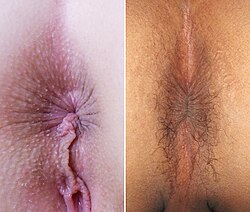 The anus of a female with a prominent perineal raphe (left) and a male person with anal pubic hair (right). | |
| Identifiers | |
| TA98 | A05.7.05.013 |
| TA2 | 3022 |
| FMA | 15711 |
| Anatomical terminology [edit on Wikidata] | |
In humans, the anus (from Latin anus pregnant "ring", "circumvolve")[one] [2] is the external opening of the rectum, located inside the intergluteal crevice and separated from the genitals past the perineum. Two sphincters control the exit of feces from the body during an deed of defecation, which is the principal office of the anus. These are the internal anal sphincter and the external anal sphincter, which are round muscles that normally maintain constriction of the orifice and which relaxes as required past normal physiological operation. The inner sphincter is involuntary and the outer is voluntary. It is located behind the perineum which is located backside the vagina or scrotum.
In role attributable to its exposure to feces, a number of medical conditions may affect the anus such as hemorrhoids.[3] The anus is the site of potential infections and other conditions, including cancer (see Anal cancer).[4]
With anal sexual practice, the anus tin play a role in sexuality. Attitudes toward anal sex activity vary, and it is illegal in some countries.[v] The anus is often considered a taboo part of the body,[5] and is known by many unremarkably vulgar slang terms. Some sexually transmitted infections including HIV/AIDS and anal warts can be spread via anal sex.
Structure
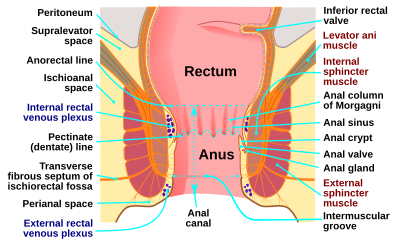
Anatomy of the homo anus. Frontal section.
The anus is the terminal part of the gastrointestinal tract, and directly continues from the rectum. The anus passes through the pelvic flooring. The anus is surrounded by muscles. The top and bottom of the anus are surrounded by the internal and external anal sphincters, two muscular rings which control defecation.[6] : 397 The anus is surrounded in its length past folds chosen anal valves, which converge at a line known equally the pectinate line. This represents the point of transition between the hindgut and the ectoderm in the embryo. Below this bespeak, the mucosa of the internal anus becomes skin.[6] : 397 The pectinate line is also the partitioning between the internal and external anus.
The anus receives blood from the inferior rectal artery and innervation from the inferior rectal nerves, which branch from the pudendal nerve.[seven]
Microanatomy
The pseudostratified columnar epithelium of the alimentary canal transitions to stratified squamous epithelium at the pectinate line. The stratified squamous epithelium gradually accumulates sebaceous and apocrine glands.[8] : 285
Evolution
During puberty, as testosterone triggers androgenic hair growth on the trunk, pubic hair begins to appear around the anus. Although initially sparse, information technology fills out by the cease of puberty, if not earlier. In some genetic populations, androgenic hair is less common.
Function
Defecation
Intra-rectal pressure builds as the rectum fills with feces, pushing the feces against the walls of the anal canal. Contractions of abdominal and pelvic flooring muscles can create intra-abdominal pressure which farther increases intra-rectal pressure. The internal anal sphincter (an involuntary muscle) responds to the pressure by relaxing, thus allowing the feces to enter the culvert. The rectum shortens as carrion are pushed into the anal canal and peristaltic waves button the feces out of the rectum. Relaxation of the internal and external anal sphincters allows the carrion to exit from the anus, finally, equally the levator ani muscles pull the anus upwardly over the exiting feces.
Clinical significance
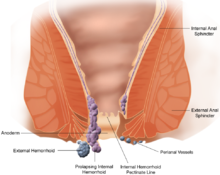
Image of the anus affected past hemorrhoids. The pectinate line, which separates the internal from the external anus, can be seen.
Anal fissures, which are tears in the external lining of the lining (mucosa) of the anus. These are exquisitely painful, with hurting occurring after a motion is passed; other symptoms may include modest bleeding, discharge, or crawling.[9] Generally, fissures are due to injury to the mucosa, or because of a poor local blood supply that prevents proper healing, with spasm of the external anal sphincter contributing.[nine] The external anal sphincter can be relaxed by the application of glyceryl trinitrate creams, and constipation is managed with laxatives and improving hydration.[9] Some fissures may require botulinum toxin injection; worst cases may require surgical intervention such as "lateral internal anal sphincterotomy or advancement anoplasty"[ clarification needed ].[nine]
Hemorrhoids, which are visible blood vessels from the internal or external venous plexuses of the anus. Haemorrhoids may cause bleeding after passing a motion; may exist painful; may cause an itch; may prolapse out of the anus.[9] Haemorrhoids are frequently associated with straining due to constipation, and pregnancy.[9] Normally, haemorrhoids are managed with medications to make motions more soft and prevent straining during constipation. Some haemorrhoids require surgery to manage, which may involve placing a band around the haemorrhoid, in order for information technology to lose blood supply; or surgical excision.[nine]
Other
- Fistula
- Nascency defects, including imperforation, stenosis, Tailgut cyst
Infections
Anal abscesses normally result from infection of the normal glands of the anus, or sometimes considering of Crohn'south disease.[9] They usually occur to the sides of the sphincters, and betwixt the internal and external sphincters, either on the surface, or deeper. They may become bigger, enlarging in the direction of the rectum, and resulting in an abnormal connection called an anorectal fistula. They are usually managed with surgical drainage[9] and antibiotics.[10] [11]
Additional
- Sexually transmitted infections
- Anal warts, likewise called "anal condyloma"
Cancer
![[icon]](https://upload.wikimedia.org/wikipedia/commons/thumb/1/1c/Wiki_letter_w_cropped.svg/20px-Wiki_letter_w_cropped.svg.png) | This department needs expansion. You tin can aid by adding to information technology. (June 2020) |
Anal cancer, also called "anal carcinoma", and Anal intraepithelial neoplasia[12]
Itching, incontinence and constipation
Itchiness chosen Pruritus ani, can bear upon the anus surface area. It is nearly often due to long-term exposure of the anus to faeces, with reasons including diseases of the anus such as haemorrhoids, fistulas and fissures; poor hygiene or chronic diarrhoea; local infections such equally tapeworm and thrush, pare conditions such as psoriasis and contact dermatitis. If at that place is a specific cause identified, the cause may exist treated to salve the itch. Otherwise, treatment includes keeping the area clean and dry out, ceasing topical creams and ointments, and potentially bulk-forming laxatives to reduce the chance of faecal contagion.[9]
Harm or injury to the anal sphincter (patulous anus in more severe cases) as a result of impairment during surgery, such as to the perineal region, or resulting from anal sex; can lead to flatus and/or fecal incontinence, chronic constipation and megacolon.[xiii]
Guild and civilisation
Sexuality
The anus has a relatively loftier concentration of nerve endings and can be an erogenous zone, which can brand anal intercourse pleasurable if performed properly. The pudendal nerve that branches to supply the external anal sphincter also branches to the dorsal nerve of the clitoris and the dorsal nerve of the penis.[fourteen]
In addition to nerve endings, pleasure from anal intercourse may be aided past the close proximity betwixt the anus and the prostate for males, and vagina, clitoral legs and anal area for females. This is considering of indirect stimulation of the prostate and vagina or clitoral legs.[14] [15] [xvi] For a male insertive partner, the tightness of the anus tin can be a source of pleasure via the tactile pressure on the penis.[17] [18] Pleasure from the anus can also exist achieved through anal masturbation, fingering,[5] facesitting, anilingus, and other penetrative and non-penetrative acts. Anal stretching or fisting is pleasurable for some, just it poses a more serious threat of damage due to the deliberate stretching of the anal and rectal tissues; its injuries include anal sphincter lacerations and rectal and sigmoid colon (rectosigmoid) perforation, which might effect in death.[19] Lubricant and condoms are widely regarded as a necessity while performing anal sex as well every bit a slow and cautious penetration.[twenty]
Anal intercourse is sometimes referred to as sodomy or buggery, and is considered taboo in a number of legal systems. It has been, and in some jurisdictions continues to be, a crime conveying astringent penalty.[5]
Hygiene
To preclude diseases of the anus[ citation needed ] and to promote general hygiene, humans frequently make clean the outside of the anus after elimination the bowels. A rinse with h2o from a bidet or a wipe with toilet paper is often used for this purpose, though anal cleansing practices vary greatly between cultures.
Cosmetics
Shaving, trimming, depilatory (hair removal), or Brazilian waxing tin can articulate the perineum of hair.
Anal bleaching is a process in which the anus and perineum, which may darken after puberty depending on private genetics, is lightened for a more youthful appearance.
True anal piercing is rare because it may interfere with the function of the anus. Surface piercings of the perineum are easier to care for and much more common.
Additional images
-
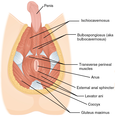
Muscles of the male person perineum
-

Muscles of the female perineum
-
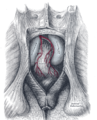
The posterior aspect of the rectum and anus exposed by removing the lower office of the sacrum and the coccyx
See too
 | Look upward anus in Wiktionary, the gratuitous dictionary. |
 | Wikimedia Eatables has media related to Human being anus. |
- Anal bleaching
- Anal phase (Freudian psychosexual stage)
- Anococcygeal nerve
- Buttocks
- Cloaca
- Coccydynia
- Coccyx
- Digestive system
- Flatulence
References
- ^ Martim de Albuquerque (1873). Notes and Queries. Original from the University of Michigan: Oxford Academy Press. p. 119.
- ^ Edward O'Reilly; John O'Donovan (1864). An Irish-English language Dictionary. Original from Oxford University: J. Duffy. p. 7.
- ^ Schubert, MC; Sridhar, S; Schade, RR; Wexner, SD (July 2009). "What every gastroenterologist needs to know virtually common anorectal disorders". World J Gastroenterol. 15 (26): 3201–09. doi:ten.3748/wjg.15.3201. ISSN 1007-9327. PMC2710774. PMID 19598294.
- ^ "Anal Cancer". The Lecturio Medical Concept Library . Retrieved 24 July 2021.
- ^ a b c d "Anal Sexual practice, defined". Discovery.com. Archived from the original on June 13, 2002. Retrieved July 23, 2013.
- ^ a b Drake, Richard L.; Vogl, Wayne; Tibbitts, Adam Westward.M. Mitchell (2005). Greyness's anatomy for students. illustrations by Richard; Richardson, Paul. Philadelphia: Elsevier/Churchill Livingstone. ISBN978-0-8089-2306-0.
- ^ Moore, Keith Fifty.; Dalley, Arthur F.; Agur, A. Chiliad. R. (2013-02-xiii). Clinically Oriented Beefcake. Lippincott Williams & Wilkins. ISBN9781451119459.
- ^ Deakin, Barbara Young; et al. (2006). Wheater's functional histology : a text and colour atlas. drawings by Philip J. (fifth ed.). Churchill Livingstone/Elsevier. ISBN978-0-443-06850-8.
- ^ a b c d e f one thousand h i j Ralston, Stuart H.; Penman, Ian D.; Strachan, Mark W.; Hobson, Richard P. (eds.) (2018). "Anorectal disorders". Davidson's principles and do of medicine (23rd ed.). Elsevier. pp. 835–6. ISBN978-0-7020-7028-0.
- ^ "Anorectal Abscess". Johns Hopkins Medicine . Retrieved 10 August 2021.
- ^ Ansorge, R; Robinson, J (15 September 2019). "Anal Abscess". WebMD . Retrieved 10 August 2021.
- ^ "Anal Cancer". The Lecturio Medical Concept Library . Retrieved 10 August 2021.
- ^ "Megacolon". The Lecturio Medical Concept Library . Retrieved 10 Baronial 2021.
- ^ a b Komisaruk, Barry R.; Whipple, Beverly; Nasserzadeh, Sara; Beyer-Flores, Carlos (2009). The Orgasm Answer Guide. JHU Press. pp. 108–109. ISBN978-0-8018-9396-iv . Retrieved Jan 20, 2014.
- ^ Rosenthal, Martha (2012). Human being Sexuality: From Cells to Order. Cengage Learning. pp. 133–135. ISBN978-0-618-75571-4 . Retrieved September 17, 2012.
- ^ Natasha Janina, Valdez (2011). Vitamin O: Why Orgasms Are Vital to a Woman'southward Wellness and Happiness, and How to Take Them Every Time!. Skyhorse Publishing Inc. p. 79. ISBN978-i-61608-311-iii . Retrieved Nov 6, 2011.
- ^ "Anal Sex Safety and Health Concerns". WebMD. Retrieved Baronial 19, 2013.
- ^ Joann S. DeLora; Carol A. B. Warren; Carol Rinkleib Ellison (2008) [1981]. Understanding Sexual Interaction. Houghton Mifflin (Original from the University of Virginia). p. 123. ISBN978-0-395-29724-7 . Retrieved November 6, 2011.
Many men detect anal intercourse more than heady than penile-vaginal intercourse because the anal opening is commonly smaller and tighter than the vagina. Probably the forbidden attribute of anal intercourse also makes information technology more than exciting for some people.
- ^ John J. Miletich; Tia Laura Lindstrom (2010). An Introduction to the Piece of work of a Medical Examiner: From Death Scene to Autopsy Suite. ABC-CLIO. p. 29. ISBN978-0275995089 . Retrieved September 15, 2014.
- ^ Carroll, Janell L. (2009). Sexuality Now: Embracing Diversity. Cengage Learning. p. 271. ISBN978-0-495-60274-3 . Retrieved 2010-12-19 .
Source: https://en.wikipedia.org/wiki/Human_anus
0 Response to "What Is My Anus Supposed to Look Like"
Postar um comentário