Easy Asian Art to Draw Simple Chinese Art to Drawn by an Artist

The history of Asian art includes a vast range of arts from various cultures, regions and religions across the continent of Asia. The major regions of Asia include Central, East, South, Southeast, and West Asia.
Central Asian art primarily consists of works past the Turkic peoples of the Eurasian Steppe, while East Asian art includes works from Mainland china, Nihon, and Korea. S Asian art encompasses the arts of the Indian subcontinent, with Southeast Asian art including the art of Thailand, Laos, Vietnam, Republic of indonesia, and the Philippines. West Asian art encompasses the arts of the Near E, including the ancient art of Mesopotamia, and more recently becoming dominated past Islamic art.
In many ways, the history of art in Asia parallels the evolution of Western art.[1] [2] The art histories of Asia and Europe are greatly intertwined, with Asian fine art profoundly influencing European art, and vice versa; the cultures mixed through methods such every bit the Silk Road transmission of art, the cultural exchange of the Age of Discovery and colonization, and through the internet and modernistic globalization.[3] [iv] [five]
Excluding prehistoric art, the art of Mesopotamia represents the oldest forms of art in Asia.
Central Asian art [edit]
Fine art in Central Asia is visual fine art created by the largely Turkic peoples of modern-twenty-four hour period Kyrgyzstan, Kazakhstan, Uzbekistan, Turkmenistan, Azerbaijan, Tajikistan, Mongolia, Tibet, Afghanistan, and Pakistan also equally parts of China and Russia.[6] [7] In recent centuries, fine art in the region have been greatly influenced by Islamic fine art. Earlier Key Asian fine art was influenced by Chinese, Greek, and Persian fine art, via the Silk Road transmission of art.[viii]
Nomadic folk art [edit]
Nomad Folk art serves as a vital aspect of Cardinal Asian Art. The art reflects the core of the lifestyle of nomadic groups residing within the region. One is bound to be awestruck past the beauty of semi-precious stones, quilt, carved door, and embroidered carpets that this art reflects.[9] [x]
Music and musical instrument [edit]
Cardinal Asia is enriched with the classical music and instruments. Some of the famous classical musical instruments were originated within the Key Asian region. Rubab, Dombra, and Chang are some of the musical instruments used in the musical arts of Central Asia.[11]
The revival of Central Asian art [edit]
The lives of Central Asian people revolved around nomadic lifestyle. Thereby almost of the Central Asian arts in the modern times are also inspired by nomadic living showcasing the golden era. As the matter of fact, the touch on of tradition and culture in Cardinal Asian art act as a major attraction factor for the international art forums. The global recognition towards the Key Asian Art has certainly added up to its worth.[12]
E Asian art [edit]

Chinese fine art [edit]
Chinese art (Chinese: 中國藝術/中国艺术) has varied throughout its ancient history, divided into periods past the ruling dynasties of Red china and changing technology. Different forms of art have been influenced by smashing philosophers, teachers, religious figures and even political leaders. Chinese art encompasses fine arts, folk arts and functioning arts. Chinese art is art, whether mod or ancient, that originated in or is practiced in China or by Chinese artists or performers.
In the Song Dynasty, poetry was marked by a lyric poetry known as Ci (詞) which expressed feelings of want, ofttimes in an adopted persona. Also in the Song dynasty, paintings of more subtle expression of landscapes appeared, with blurred outlines and mountain contours which conveyed altitude through an impressionistic treatment of natural phenomena. It was during this period that in painting, accent was placed on spiritual rather than emotional elements, as in the previous period. Kunqu, the oldest extant form of Chinese opera developed during the Song Dynasty in Kunshan, near nowadays-day Shanghai. In the Yuan dynasty, painting by the Chinese painter Zhao Mengfu (趙孟頫) profoundly influenced afterward Chinese landscape painting, and the Yuan dynasty opera became a variant of Chinese opera which continues today equally Cantonese opera.
Chinese painting and calligraphy art [edit]
Chinese painting
Gongbi and Xieyi are two painting styles in Chinese painting.
Gongbi means "meticulous", the rich colours and details in the picture are its main features, its content mainly depicts portraits or narratives. Xieyi means 'freehand', its form is often exaggerated and unreal, with an emphasis on the author's emotional expression and usually used in depicting landscapes.[thirteen]
In improver to paper and silk, traditional paintings take also been done on the walls, such as the Mogao Grottoes in Gansu Province. The Dunhuang Mogao Grottoes were congenital in the Northern Wei Dynasty (386–534 Advertisement). It consists of more than 700 caves, of which 492 caves have murals on the walls, totalling more than than 45,000 foursquare meters.[14] [xv] The murals are very broad in content, include Buddha statues, paradise, angels, of import historical events and even donors. The painting styles in early cave received influence from India and the West. From the Tang Dynasty (618–906 CE), the murals began to reverberate the unique Chinese painting style.[xvi]

Chinese Calligraphy

The Chinese calligraphy can be traced dorsum to the Dazhuan (large seal script) that appeared in the Zhou Dynasty. After Emperor Qin unified Cathay, Prime Minister Li Si collected and compiled Xiaozhuan (small seal) mode as a new official text. The pocket-sized seal script is very elegant but hard to write quickly. In the Eastern Han Dynasty, a blazon of script called the Lishu (Official Script) began to rise. Because it reveals no circles and very few curved lines, it is very suitable for fast writing. Later on that, the Kaishu style (traditional regular script) has appeared, and its structure is simpler and neater, this script is nonetheless widely used today.[17] [xviii]
Ancient Chinese crafts [edit]

Bluish and white porcelain dish
Jade
Early jade was used as an decoration or sacrificial utensils. The earliest Chinese carved-jade object appeared in the Hemudu culture in the early Neolithic period (nigh 3500–2000 BCE). During the Shang dynasty (c. 1600–1046 bce), Bi (circular perforated jade) and Cong (square jade tube) appeared, which were guessed as sacrificial utensils, representing the sky and the earth. In the Zhou Dynasty (1046–256 bce), due to the using of higher hardness engraving tools, jades were carved more delicately and began to be used as a pendant or ornament in clothing.[nineteen] [20] Jade was considered to be immortal and could protect the owner, and then carved-jade objects were ofttimes buried with the deceased, such equally a jade burial suit from the tomb of Liu Sheng, a prince of the Western Han Dynasty.[20] [21]
Porcelain
Porcelain is a kind of ceramics made from kaolin at loftier temperature. The primeval ceramics in Cathay appeared in the Shang Dynasty (c.1600–1046 BCE). And the production of ceramics laid the foundation for the invention of porcelain. The history of Chinese porcelain tin be traced dorsum to the Han Dynasty (206 BC – 220 Advertizing).[22] In the Tang Dynasty, porcelain was divided into celadon and white porcelain. In the Vocal Dynasty, Jingdezhen was selected as the purple porcelain production heart and began to produce blueish and white porcelain.[23]
Modern Chinese fine art [edit]
After the terminate of the terminal feudal dynasty in China, with the rise of the new cultural motion, Chinese artists began to be influenced past Western art and began to integrate Western fine art into Chinese civilisation.[24] Influenced by American jazz, Chinese composer Li Jinhui (Known as the father of Chinese pop music) began to create and promote popular music, which made a huge sensation.[25] At the commencement of the 20th century, oil paintings were introduced to Mainland china, and more and more Chinese painters began to bear on Western painting techniques and combine them with traditional Chinese painting.[26] Meanwhile, a new form of painting, comics, has also begun to rise. It was popular with many people and became the most affordable manner to entertain at the fourth dimension.[27]
Tibetan art [edit]


Jina Buddha Ratnasambhava, central Tibet, Kadampa Monastery, 1150–1225.
Tibetan art refers to the art of Tibet (Tibet Autonomous Region in China) and other present and one-time Himalayan kingdoms (Bhutan, Ladakh, Nepal, and Sikkim). Tibetan art is first and foremost a form of sacred fine art, reflecting the over-riding influence of Tibetan Buddhism on these cultures. The Sand Mandala (Tib: kilkhor) is a Tibetan Buddhist tradition which symbolises the transitory nature of things. Equally part of Buddhist canon, all things material are seen as transitory. A sand mandala is an case of this, being that once it has been built and its accompanying ceremonies and viewing are finished, it is systematically destroyed.
As Mahayana Buddhism emerged equally a carve up school in the 4th century BC information technology emphasized the role of bodhisattvas, compassionate beings who forgo their personal escape to Nirvana in guild to assist others. From an early fourth dimension diverse bodhisattvas were besides subjects of bronze art. Tibetan Buddhism, as an offspring of Mahayana Buddhism, inherited this tradition. Simply the additional dominating presence of the Vajrayana (or Buddhist tantra) may accept had an overriding importance in the artistic civilisation. A common bodhisattva depicted in Tibetan art is the deity Chenrezig (Avalokitesvara), often portrayed as a grand-armed saint with an center in the middle of each hand, representing the all-seeing compassionate one who hears our requests. This deity can also exist understood as a Yidam, or 'meditation Buddha' for Vajrayana practice.
Tibetan Buddhism contains Tantric Buddhism, also known as Vajrayana Buddhism for its common symbolism of the vajra, the diamond thunderbolt (known in Tibetan as the dorje). Almost of the typical Tibetan Buddhist art can be seen as part of the practice of tantra. Vajrayana techniques contain many visualizations/imaginations during meditation, and most of the elaborate tantric art can be seen as aids to these visualizations; from representations of meditational deities (yidams) to mandalas and all kinds of ritual implements.
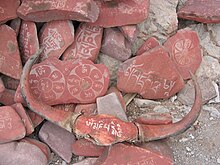
In Tibet, many Buddhists carve mantras into rocks as a form of devotion.
A visual aspect of Tantric Buddhism is the common representation of wrathful deities, often depicted with aroused faces, circles of flame, or with the skulls of the dead. These images represent the Protectors (Skt. dharmapala) and their fearsome bearing belies their true compassionate nature. Really, their wrath represents their dedication to the protection of the dharma teaching as well as to the protection of the specific tantric practices to prevent abuse or disruption of the practice. They are nigh importantly used as wrathful psychological aspects that can be used to conquer the negative attitudes of the practitioner.
Historians note that Chinese painting had a profound influence on Tibetan painting in general. Starting from the 14th and 15th century, Tibetan painting had incorporated many elements from the Chinese, and during the 18th century, Chinese painting had a deep and far-stretched impact on Tibetan visual fine art.[28] Co-ordinate to Giuseppe Tucci, past the time of the Qing Dynasty, "a new Tibetan art was then developed, which in a certain sense was a provincial echo of the Chinese 18th century'due south smoothen ornate preciosity."[28]
Japanese art [edit]
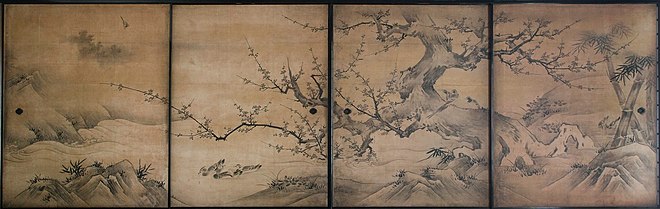
Four from a prepare of sixteen sliding room partitions (Birds and Blossom of the Four Seasons [29]) fabricated for a 16th-century Japanese abbot. Typically for later Japanese landscapes, the chief focus is on a feature in the foreground.
Japanese fine art and architecture is works of fine art produced in Japan from the beginnings of human habitation there, sometime in the 10th millennium BC, to the present. Japanese art covers a broad range of fine art styles and media, including ancient pottery, sculpture in forest and bronze, ink painting on silk and paper, and a myriad of other types of works of art; from aboriginal times until the contemporary 21st century.
The fine art form rose to groovy popularity in the metropolitan culture of Edo (Tokyo) during the 2nd one-half of the 17th century, originating with the single-color works of Hishikawa Moronobu in the 1670s. At first, only India ink was used, then some prints were manually colored with a brush, but in the 18th century Suzuki Harunobu adult the technique of polychrome printing to produce nishiki-e.

Japanese painting ( 絵画 , Kaiga ) is 1 of the oldest and near highly refined of the Japanese arts, encompassing a wide variety of genre and styles. As with the history of Japanese arts in full general, the history of Japanese painting is a long history of synthesis and competition between native Japanese aesthetics and adaptation of imported ideas.
The origins of painting in Japan date well back into Japan's prehistoric period. Uncomplicated stick figures and geometric designs tin can be found on Jōmon period pottery and Yayoi menses (300 BC – 300 Advertizement) dōtaku bronze bells. Mural paintings with both geometric and figurative designs have been found in numerous tumulus from the Kofun period (300–700 Advert).
Ancient Japanese sculpture was mostly derived from the idol worship in Buddhism or animistic rites of Shinto deity. In particular, sculpture among all the arts came to be most firmly centered around Buddhism. Materials traditionally used were metallic—specially statuary—and, more commonly, wood, often lacquered, golden, or brightly painted. By the end of the Tokugawa menstruation, such traditional sculpture – except for miniaturized works – had largely disappeared because of the loss of patronage by Buddhist temples and the dignity.
Ukiyo, significant "floating world", refers to the impetuous immature culture that bloomed in the urban centers of Edo (modern-day Tokyo), Osaka, and Kyoto that were a world unto themselves. Information technology is an ironic allusion to the homophone term "Sorrowful World" (憂き世), the earthly plane of death and rebirth from which Buddhists sought release.
Korean art [edit]
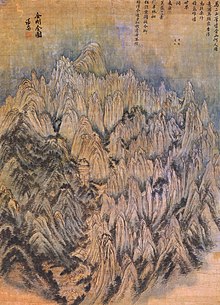
Jeong Seon, Full general View of Mt. Geumgang (금강전도, 金剛全圖), Korea, c.1734
Korean fine art is noted for its traditions in pottery, music, calligraphy, painting, sculpture, and other genres, often marked by the use of assuming color, natural forms, precise shape and scale, and surface decoration.
While there are articulate and distinguishing differences between three independent cultures, there are pregnant and historical similarities and interactions betwixt the arts of Korea, China and Nippon.
The study and appreciation of Korean art is still at a determinative stage in the West. Because of Korea's position between Prc and Japan, Korea was seen as a mere conduit of Chinese civilization to Japan. Notwithstanding, recent scholars have begun to admit Korea's own unique art, culture and of import role in non just transmitting Chinese civilisation simply assimilating information technology and creating a unique culture of its ain. An art given birth to and developed by a nation is its own fine art.
Generally, the history of Korean painting is dated to approximately 108 C.E., when information technology first appears as an independent form. Between that fourth dimension and the paintings and frescoes that announced on the Goryeo dynasty tombs, in that location has been little enquiry. Suffice to say that til the Joseon dynasty the primary influence was Chinese painting though washed with Korean landscapes, facial features, Buddhist topics, and an emphasis on celestial observation in keeping with the rapid development of Korean astronomy.
Throughout the history of Korean painting, in that location has been a constant separation of monochromatic works of black brushwork on very often mulberry paper or silk; and the colourful folk fine art or min-hwa, ritual arts, tomb paintings, and festival arts which had extensive use of colour.
This stardom was often class-based: scholars, specially in Confucian art felt that i could come across colour in monochromatic paintings within the gradations and felt that the actual use of colour coarsened the paintings, and restricted the imagination. Korean folk fine art, and painting of architectural frames was seen as brightening sure outside wood frames, and once more within the tradition of Chinese architecture, and the early Buddhist influences of profuse rich thalo and primary colours inspired by Art of India.
Gimmicky art in Korea: The first example of Western-way oil painting in Korean fine art was in the self-portraits of Korean creative person Ko Hu i-dong (1886–1965). But three of these works still remain today. these self-portraits impart an understanding of medium that extends well beyond the affidavit of stylistic and cultural departure. by the early twentieth century, the decision to paint using oil and canvas in Korea had two different interpretations. One being a sense of enlightenment due to western ideas and fine art styles. This enlightenment derived from an intellectual movement of the seventeenth and eighteenth centuries. Ko had been painting with this method during a period of Japan's annexation of Korea. During this time many claimed his art could have been political, however, he himself stated he was an creative person and not a politician. Ko stated "While I was in Tokyo, a very curious thing happened. At that fourth dimension there were fewer than ane hundred Korean students in Tokyo. All of us were drinking the new air and embarking on new studies, but there were some who mocked my choice to study art. A close friend said that information technology was not right for me to study painting in such a time as this." [30]
Korean pottery was recognized as early as 6000 BCE. This pottery was likewise referred to equally comb-patterned pottery due to the decorative lines carved onto the outside. early Korean societies were mainly dependent on fishing. So, they used the pottery to store fish and other things collected from the ocean such as shellfish. Pottery had ii main regional distinctions. Those from the E coast tends to take a apartment base, whereas pottery on the South declension had a round base.[31]
South Asian fine art [edit]
Pakistani art [edit]
Pakistani art has a long tradition and history. It consists of a diverseness of art forms, including painting, sculpture, calligraphy, pottery, and material arts such equally woven silk. Geographically, it is a role of Indian subcontinent art, including what is now Pakistan.[32]
Buddhist art [edit]

Buddhist art originated in the Indian subcontinent in the centuries following the life of the historical Gautama Buddha in the 6th to fifth century BCE, earlier evolving through its contact with other cultures and its diffusion through the rest of Asia and the world. Buddhist art traveled with believers every bit the dharma spread, adjusted, and evolved in each new host country. Information technology developed to the north through Central Asia and into East Asia to form the Northern co-operative of Buddhist art, and to the eastward as far as Southeast Asia to form the Southern branch of Buddhist fine art. In India, Buddhist art flourished and fifty-fifty influenced the development of Hindu art, until Buddhism about disappeared in India around the tenth century CE due in role to the vigorous expansion of Islam aslope Hinduism.
A common visual device in Buddhist art is the mandala. From a viewer's perspective, information technology represents schematically the ideal universe.[33] [34] In various spiritual traditions, mandalas may be employed for focusing the attention of aspirants and adepts, a spiritual teaching tool, for establishing a sacred space and as an aid to meditation and trance induction. Its symbolic nature tin can help one "to access progressively deeper levels of the unconscious, ultimately profitable the meditator to experience a mystical sense of oneness with the ultimate unity from which the cosmos in all its manifold forms arises."[35] The psychoanalyst Carl Jung saw the mandala equally "a representation of the centre of the unconscious self,"[36] and believed his paintings of mandalas enabled him to place emotional disorders and work towards wholeness in personality.[37]
Bhutanese art [edit]

Bhutanese fine art is similar to the art of Tibet. Both are based upon Vajrayana Buddhism, with its pantheon of divine beings.
The major orders of Buddhism in Bhutan are Drukpa Kagyu and Nyingma. The one-time is a branch of the Kagyu School and is known for paintings documenting the lineage of Buddhist masters and the 70 Je Khenpo (leaders of the Bhutanese monastic establishment). The Nyingma guild is known for images of Padmasambhava, who is credited with introducing Buddhism into Bhutan in the 7th century. According to fable, Padmasambhava hid sacred treasures for future Buddhist masters, especially Pema Lingpa, to find. The treasure finders (tertön) are also frequent subjects of Nyingma art.
Each divine being is assigned special shapes, colors, and/or identifying objects, such as lotus, conch-beat out, thunderbolt, and begging bowl. All sacred images are made to verbal specifications that have remained remarkably unchanged for centuries.

Bhutanese fine art is particularly rich in bronzes of dissimilar kinds that are collectively known by the name Kham-so (fabricated in Kham) even though they are made in Bhutan, because the technique of making them was originally imported from the eastern province of Tibet chosen Kham. Wall paintings and sculptures, in these regions, are formulated on the principal ageless ethics of Buddhist art forms. Fifty-fifty though their emphasis on detail is derived from Tibetan models, their origins can be discerned easily, despite the profusely embroidered garments and glittering ornaments with which these figures are lavishly covered. In the grotesque world of demons, the artists plainly had greater liberty of activity than when modeling images of divine beings.
The arts and crafts of Bhutan that represent the exclusive "spirit and identity of the Himalayan kingdom' are defined as the art of Zorig Chosum, which means the "thirteen arts and crafts of Bhutan"; the thirteen crafts are carpentry, painting, paper making, blacksmithery, weaving, sculpting and many other crafts. The Constitute of Zorig Chosum in Thimphu is the premier institution of traditional craft set upward by the Regime of Bhutan with the sole objective of preserving the rich civilisation and tradition of Bhutan and training students in all traditional art forms; there is some other like institution in eastern Bhutan known as Trashi Yangtse. Bhutanese rural life is likewise displayed in the 'Folk Heritage Museum' in Thimphu. At that place is likewise a 'Voluntary Artists Studio' in Thimphu to encourage and promote the art forms among the youth of Thimphu. The thirteen arts and crafts of Bhutan and the institutions established in Thimphu to promote these fine art forms are:[38] [39]
Indian fine art [edit]
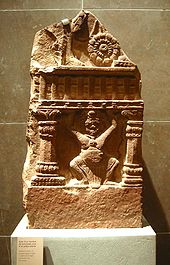

Indian fine art can be classified into specific periods, each reflecting certain religious, political and cultural developments. The earliest examples are the petroglyphs such every bit those found in Bhimbetka, some of them dating to before 5500 BC. The production of such works continued for several millenniums.
The fine art of the Indus Valley Civilization followed. Later examples include the carved pillars of Ellora, Maharashtra country. Other examples are the frescoes of Ajanta and Ellora Caves.
The contributions of the Mughal Empire to Indian art include Mughal painting, a mode of miniature painting heavily influenced past Persian miniatures, and Mughal compages.
During the British Raj, modern Indian painting evolved as a result of combining traditional Indian and European styles. Raja Ravi Varma was a pioneer of this period. The Bengal school of Fine art developed during this menses, led by Abanidranath Tagore, Gaganendranath Tagore, Jamini Roy, Mukul Dey and Nandalal Bose.
Ane of the most popular art forms in India is chosen Rangoli. Information technology is a form of sandpainting ornamentation that uses finely ground white powder and colours, and is used normally outside homes in India.
The visual arts (sculpture, painting and architecture) are tightly interrelated with the non-visual arts. According to Kapila Vatsyayan, "Classical Indian compages, sculpture, painting, literature (kaavya), music and dancing evolved their own rules conditioned past their respective media, but they shared with one another not only the underlying spiritual beliefs of the Indian religio-philosophic heed, simply also the procedures by which the relationships of the symbol and the spiritual states were worked out in detail."
Insight into the unique qualities of Indian art is best achieved through an understanding of the philosophical idea, the wide cultural history, social, religious and political groundwork of the artworks.
Specific periods:
- Hinduism and Buddhism of the ancient menstruum (3500 BCE – present)
- Islamic ascendancy (712–1757 CE)
- The colonial period (1757–1947)
- Modernistic and Postmodern fine art in India
- Independence and the postcolonial period (Post-1947)
Nepalese art [edit]
The aboriginal and refined traditional culture of Kathmandu, for that matter in the whole of Nepal, is an uninterrupted and exceptional meeting of the Hindu and Buddhist ethos practiced by its highly religious people. It has too embraced in its fold the cultural diversity provided by the other religions such as Jainism, Islam and Christianity.
Southeast Asian fine art [edit]
Cambodian art [edit]

Cambodian fine art and the civilisation of Cambodia has had a rich and varied history dating back many centuries and has been heavily influenced by Bharat. In turn, Cambodia profoundly influenced Thailand, Laos and vice versa. Throughout Cambodia's long history, a major source of inspiration was from organized religion.[40] Throughout near 2 millennium, a Cambodians developed a unique Khmer belief from the syncreticism of indigenous animistic beliefs and the Indian religions of Buddhism and Hinduism. Indian culture and civilization, including its language and arts reached mainland Southeast Asia around the 1st century CE.[41] It is more often than not believed that seafaring merchants brought Indian customs and civilisation to ports along the gulf of Thailand and the Pacific while trading with Mainland china. The kickoff state to benefit from this was Funan. At various times, Cambodia culture also captivated elements from Javanese, Chinese, Lao, and Thai cultures.[42]
Visual arts of Cambodia [edit]
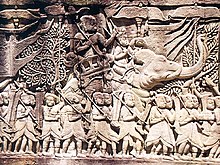
Rock bas-relief at Bayon temple depicting the Khmer ground forces at war with the Cham, carved c. 1200 CE
The history of Visual arts of Cambodia stretches back centuries to aboriginal crafts; Khmer art reached its superlative during the Angkor period. Traditional Cambodian arts and crafts include textiles, non-fabric weaving, silversmithing, rock carving, lacquerware, ceramics, wat murals, and kite-making.[43] Start in the mid-20th century, a tradition of modern art began in Cambodia, though in the afterwards 20th century both traditional and mod arts declined for several reasons, including the killing of artists by the Khmer Rouge. The land has experienced a recent artistic revival due to increased support from governments, NGOs, and foreign tourists.[44]
Khmer sculpture refers to the stone sculpture of the Khmer Empire, which ruled a territory based on mod Kingdom of cambodia, simply rather larger, from the ninth to the 13th century. The virtually historic examples are plant in Angkor, which served as the seat of the empire.
Past the seventh century, Central khmer sculpture begins to drift away from its Hindu influences – pre-Gupta for the Buddhist figures, Pallava for the Hindu figures – and through constant stylistic evolution, it comes to develop its own originality, which by the 10th century can be considered complete and accented. Central khmer sculpture soon goes across religious representation, which becomes almost a pretext in order to portray court figures in the guise of gods and goddesses.[45] But furthermore, information technology also comes to institute a ways and finish in itself for the execution of stylistic refinement, like a kind of testing ground. We have already seen how the social context of the Khmer kingdom provides a second key to agreement this fine art. Merely nosotros can as well imagine that on a more exclusive level, small-scale groups of intellectuals and artists were at work, competing among themselves in mastery and refinement equally they pursued a hypothetical perfection of style.[46]
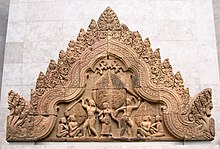
The gods nosotros find in Khmer sculpture are those of the ii great religions of India, Buddhism and Hinduism. And they are always represented with great iconographic precision, conspicuously indicating that learned priests supervised the execution of the works.[42] Yet, different those Hindu images which repeat an idealized stereotype, these images are treated with bully realism and originality because they draw living models: the king and his court. The truthful social function of Central khmer art was, in fact, the glorification of the elite through these images of the gods embodied in the princes. In fact, the cult of the "deva-raja" required the evolution of an eminently aristocratic art in which the people were supposed to see the tangible proof of the sovereign's divinity, while the elite took pleasure in seeing itself – if, information technology's true, in arcadian form – immortalized in the splendour of intricate adornments, elegant dresses and extravagant jewelry.[47]
The sculptures are beauteous images of a gods, majestic and imposing presences, though not without feminine sensuality, makes the states recall of of import persons at the courts, persons of considerable ability. The artists who sculpted the stones doubtless satisfied the principal objectives and requisites demanded by the persons who deputed them. The sculptures represent the chosen divinity in the orthodox manner and succeed in portraying, with bang-up skill and expertise, high figures of the courts in all of their splendour, in the attire, adornments and jewelry of a sophisticated beauty.[48]
Indonesian art [edit]

Indonesian art and culture has been shaped past long interaction between original indigenous customs and multiple foreign influences. Indonesia is key along ancient trading routes between the Far East and the Centre East, resulting in many cultural practices being strongly influenced by a multitude of religions, including Hinduism, Buddhism, Confucianism and Islam, all potent in the major trading cities. The result is a complex cultural mixture very unlike from the original ethnic cultures. Republic of indonesia is non generally known for paintings, bated from the intricate and expressive Balinese paintings, which often limited natural scenes and themes from the traditional dances.

Other exceptions include indigenous Kenyah paint designs based on, as commonly institute amidst Austronesian cultures, endemic natural motifs such as ferns, trees, dogs, hornbills and man figures. These are all the same to be found decorating the walls of Kenyah Dayak longhouses in Eastward Kalimantan's Apo Kayan region.
Republic of indonesia has a long-he Bronze and Atomic number 26 Ages, but the art-class particularly flourished from the eighth century to the tenth century, both as stand-lonely works of art, and also incorporated into temples.
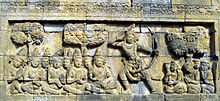
Relief sculpture from Borobudur temple, c. 760–830 Advertizing
Most notable are the hundreds of meters of relief sculpture at the temple of Borobudur in fundamental Java. Approximately two miles of exquisite relief sculpture tell the story of the life of Buddha and illustrate his teachings. The temple was originally habitation to 504 statues of the seated Buddha. This site, as with others in central Java, show a clear Indian influence.
Calligraphy, mostly based on the Qur'an, is often used as decoration as Islam forbids naturalistic depictions. Some foreign painters have besides settled in Republic of indonesia. Modern Indonesian painters utilise a wide diversity of styles and themes.
Balinese art [edit]

Balinese painting of Ramayana scene from Kerta Gosha, depicting Rama versus Dasamukha (Ravana).
Balinese art is art of Hindu-Javanese origin that grew from the work of artisans of the Majapahit Kingdom, with their expansion to Bali in the late 13th century. From the 16th until the 20th centuries, the village of Kamasan, Klungkung (Eastward Bali), was the eye of classical Balinese fine art. During the first office of the 20th century, new varieties of Balinese fine art developed. Since the late twentieth century, Ubud and its neighboring villages established a reputation equally the centre of Balinese fine art. Ubud and Batuan are known for their paintings, Mas for their woodcarvings, Celuk for gold and silversmiths, and Batubulan for their stone carvings. Covarrubias[49] describes Balinese art as, "... a highly developed, although breezy Baroque folk art that combines the peasant liveliness with the refinement of classicism of Hinduistic Java, but free of the conservative prejudice and with a new vitality fired by the exuberance of the demonic spirit of the tropical primitive". Eiseman correctly pointed out that Balinese art is really carved, painted, woven, and prepared into objects intended for everyday utilize rather than equally object d 'fine art. [50]
In the 1920s, with the arrival of many western artists, Bali became an artist enclave (as Tahiti was for Paul Gauguin) for avant-garde artists such as Walter Spies (German), Rudolf Bonnet (Dutch), Adrien-Jean Le Mayeur (Belgian), Arie Smit (Dutch) and Donald Friend (Australian) in more recent years. Most of these western artists had very niggling influence on the Balinese until the post-World War Ii period, although some accounts over-emphasise the western presence at the expense of recognising Balinese creativity.
This groundbreaking period of inventiveness reached a top in the late 1930s. A stream of famous visitors, including Charlie Chaplin and the anthropologists Gregory Bateson and Margaret Mead, encouraged the talented locals to create highly original works. During their stay in Bali in the mid-1930s, Bateson and Mead collected over 2000 paintings, predominantly from the hamlet of Batuan, just likewise from the littoral village of Sanur.[51] Among western artists, Spies and Bonnet are oftentimes credited for the modernization of traditional Balinese paintings. From the 1950s onwards Baliese artists incorporated aspects of perspective and anatomy from these artists.[52] More importantly, they acted every bit agents of change by encouraging experimentation, and promoted departures from tradition. The result was an explosion of individual expression that increased the rate of modify in Balinese art.
Laotian art [edit]


Stone carvings, called Chaityas, seen fifty-fifty in street corners and courtyards of Kathmandu
Laotian fine art includes ceramics, Lao Buddhist sculpture, and Lao music.
Lao Buddhist sculptures were created in a large variety of material including aureate, silver and most ofttimes bronze. Brick-and-mortar also was a medium used for colossal images, a famous of these is the prototype of Phya Vat (16th century) in Vientiane, although a renovation completely altered the appearance of the sculpture, and it no longer resembles a Lao Buddha. Wood is popular for small, votive Buddhist images that are frequently left in caves. Wood is also very common for big, life-size standing images of the Buddha. The most famous two sculptures carved in semi-precious rock are the Phra Keo (The Emerald Buddha) and the Phra Phuttha Butsavarat. The Phra Keo, which is probably of Xieng Sen (Chiang Saen) origin, is carved from a solid cake of jade. It rested in Vientiane for two hundred years before the Siamese carried information technology away as booty in the late 18th century. Today it serves as the palladium of the Kingdom of Thailand, and resides at the Yard Palace in Bangkok. The Phra Phuttha Butsavarat, like the Phra Keo, is also enshrined in its ain chapel at the Chiliad Palace in Bangkok. Earlier the Siamese seized it in the early on 19th century, this crystal image was the palladium of the Lao kingdom of Champassack.
Many cute Lao Buddhist sculptures are carved right into the Pak Ou caves. Most Pak Ou (rima oris of the Ou river) the Tham Ting (lower cavern) and the Tham Theung (upper cave) are near Luang Prabang, Laos. They are a magnificent grouping of caves that are but accessible past gunkhole, almost two hours upstream from the eye of Luang Prabang, and have recently get more well known and frequented by tourists. The caves are noted for their impressive Buddhist and Lao style sculptures carved into the cavern walls, and hundreds of discarded Buddhist figures laid out over the floors and wall shelves. They were put there as their owners did not wish to destroy them, so a difficult journey is fabricated to the caves to place their unwanted statue there.
Thai art [edit]

Thai art and visual art was traditionally and primarily Buddhist and Royal Art. Sculpture was almost exclusively of Buddha images, while painting was bars to illustration of books and decoration of buildings, primarily palaces and temples. Thai Buddha images from unlike periods have a number of distinctive styles. Contemporary Thai fine art often combines traditional Thai elements with modernistic techniques.
Traditional Thai paintings showed subjects in two dimensions without perspective. The size of each chemical element in the picture reflected its degree of importance. The chief technique of limerick is that of apportioning areas: the primary elements are isolated from each other by infinite transformers. This eliminated the intermediate ground, which would otherwise imply perspective. Perspective was introduced merely as a consequence of Western influence in the mid-19th century.
The near frequent narrative subjects for paintings were or are: the Jataka stories, episodes from the life of the Buddha, the Buddhist heavens and hells, and scenes of daily life.
The Sukhothai period began in the 14th century in the Sukhothai kingdom. Buddha images of the Sukhothai flow are elegant, with sinuous bodies and slender, oval faces. This style emphasized the spiritual attribute of the Buddha, by omitting many small anatomical details. The upshot was enhanced by the common practice of casting images in metal rather than etching them. This period saw the introduction of the "walking Buddha" pose.
Sukhothai artists tried to follow the canonical defining marks of a Buddha, as they are set out in aboriginal Pali texts:
- Peel so smoothen that grit cannot stick to information technology;
- Legs like a deer;
- Thighs similar a banyan tree;
- Shoulders equally massive equally an elephant'southward caput;
- Arms round similar an elephant's trunk, and long plenty to affect the knees;
- Hands like lotuses near to bloom;
- Fingertips turned back similar petals;
- head like an egg;
- Hair like scorpion stingers;
- Mentum like a mango stone;
- Nose similar a parrot's nib;
- Earlobes lengthened by the earrings of royalty;
- Eyelashes similar a moo-cow'south;
- Eyebrows like drawn bows.
Sukhothai likewise produced a large quantity of glazed ceramics in the Sawankhalok way, which were traded throughout Southeast Asia.
Vietnamese art [edit]

Ngoc Lu bronze drum'south surface, 2nd to tertiary century BCE
Vietnamese art is from 1 of the oldest of such cultures in the Southeast Asia region. A rich artistic heritage that dates to prehistoric times and includes: silk painting, sculpture, pottery, ceramics, woodblock prints, architecture, music, dance and theatre.

Tô Ngọc Vân, Thiếu nữ bên hoa huệ (Young Adult female with Lily), 1943, oil
Traditional Vietnamese art is art practiced in Vietnam or by Vietnamese artists, from ancient times (including the elaborate Đông Sơn drums) to post-Chinese domination art which was strongly influenced by Chinese Buddhist art, among other philosophies such equally Taoism and Confucianism. The fine art of Champa and French fine art also played a smaller role subsequently.
The Chinese influence on Vietnamese fine art extends into Vietnamese pottery and ceramics, calligraphy, and traditional architecture. Currently, Vietnamese lacquer paintings have proven to exist quite popular.
The Nguyễn dynasty, the last ruling dynasty of Vietnam (c. 1802–1945), saw a renewed interest in ceramics and porcelain art. Imperial courts across Asia imported Vietnamese ceramics.
Despite how highly developed the performing arts (such as purple court music and dance) became during the Nguyễn dynasty, some view other fields of arts equally beginning to refuse during the latter office of the Nguyễn dynasty.
Beginning in the 19th century, mod art and French artistic influences spread into Vietnam. In the early 20th century, the École Supérieure des Beaux Arts de fifty'Indochine (Indochina College of Arts) was founded to teach European methods and exercised influence mostly in the larger cities, such as Hanoi and Ho Chi Minh City.[53]
Travel restrictions imposed on the Vietnamese during French republic's 80-year rule of Vietnam and the long catamenia of war for national independence meant that very few Vietnamese artists were able to train or work outside of Vietnam.[54] A small number of artists from well-to-do backgrounds had the opportunity to go to France and make their careers there for the almost part.[54] Examples include Le Thi Luu, Le Pho, Mai Trung Thu, Le Van De, Le Ba Dang and Pham Tang.[54]
Modern Vietnamese artists began to utilise French techniques with many traditional mediums such equally silk, lacquer, etc., thus creating a unique blend of eastern and western elements.
Vietnamese calligraphy [edit]
Calligraphy has had a long history in Vietnam, previously using Chữ Hán forth with Chữ Nôm. However, most modern Vietnamese calligraphy instead uses the Roman-character based Chữ Quốc Ngữ, which has proven to be very popular.
In the past, with literacy in the old character-based writing systems of Vietnam beingness restricted to scholars and elites, calligraphy nevertheless still played an of import part in Vietnamese life. On special occasions such every bit the Lunar New year's day, people would go to the village teacher or scholar to make them a calligraphy hanging (often poetry, folk sayings or even single words). People who could non read or write also oftentimes commissioned scholars to write prayers which they would burn at temple shrines.
Filipino fine art [edit]

Madonna with Child ivory statue.

Lila Church ceiling paintings.

The primeval known Filipino art are the rock arts, where the oldest is the Angono Petroglyphs, made during the Neolithic age, dated between 6000 and 2000 BC. The carvings were possibly used as office of an ancient healing practise for ill children. This was followed by the Alab Petroglyphs, dated not later than 1500 BC, which exhibited symbols of fertility such every bit a pudenda. The art rock arts are petrographs, including the charcoal rock art from Peñablanca, charcoal stone art from Singnapan, red hematite fine art at Anda,[55] and the recently discovered stone art from Monreal (Ticao), depicting monkeys, man faces, worms or snakes, plants, dragonflies, and birds.[56] Between 890 and 710 BC, the Manunggul Jar was fabricated in southern Palawan. It served as a secondary burial jar, where the top cover depicts the journeying of the soul into the afterlife through a gunkhole with a psychopomp.[57] In 100 BC, the Kabayan Mummy Burial Caves were carved from a mountain. Between 5 BC-225 Advertizing, the Maitum anthropomorphic pottery were created in Cotabato. The crafts were secondary burying jars, with many depicting human heads, hands, feet, and breast.[58]
By the 4th century AD, and near likely before that, aboriginal people from the Philippines take been making behemothic warships, where the earliest known archaeological evidences have been excavated from Butuan, where the send was identified as a balangay and dated at 320 AD.[59] The oldest, currently found, artifact with a written script on it is the Laguna Copperplate Inscription, dated 900 Advertising. The plate discusses the payment of a debt.[60] The Butuan Ivory Seal is the earliest known ivory fine art in the country, dated between the ninth to 12th century Advertising. The seal contains carvings of an aboriginal script.[61] During this period, various artifacts were made, such as the Agusan image, a gold statue of a deity, mayhap influenced by Hinduism and Buddhism.[62] From the 12th to 15th century, the Butuan Silver Paleograph was made. The script on the silver has all the same to be deciphered.[63] Between the 13th–14th century, the natives of Banton, Romblon crafted the Banton cloth, the oldest surviving ikat textile in Southeast Asia. The cloth was used equally a death blanket.[64] Past the 16th century, upwardly to the late 19th century, Spanish colonization influenced various forms of fine art in the country.[65]
From 1565 to 1815, Filipino craftsfolk were making the Manila galleons used for the trading of Asia to the Americas, where many of the goods go into Europe.[66] In 1565, the aboriginal tradition of tattooing in the Philippines was first recorded through the Pintados.[67] In 1584, Fort San Antonio Abad was completed, while in 1591, Fort Santiago was built. By 1600, the Rice Terraces of the Philippine Cordilleras were fabricated. Five rice terrace clusters have been designated every bit Globe Heritage Sites.[68] In 1607, the San Agustin Church building (Manila) was congenital. The building has been declared as a World Heritage Site. The site is famous for its painted interior.[69] In 1613, the oldest surviving suyat writing on newspaper was written through the University of Santo Tomas Baybayin Documents.[70] Following 1621, the Monreal Stones were created in Ticao, Masbate.[71] In 1680, the Arch of the Centuries was made. In 1692, the epitome of Nuestra Senora de la Soledad de Porta Vaga was painted.[72]
Manaoag Church building was established in 1701. In 1710, the Earth Heritage Site of Paoay Church building was built. The church is known for its giant buttresses, role of the earthquake Bizarre architecture.[69] In 1720, the religious paintings at Camarin de da Virgen in Santa Ana were made.[73] In 1725, the historical Santa Ana Church building was built. In 1765, the World Heritage Site of Santa Maria Church was congenital. The site is notable for its highland structure.[69] Bacarra Church building was built in 1782. In 1783, the idjangs, castle-fortresses, of Batanes were get-go recorded. The exact age of the structures are all the same unknown.[74] In 1797, the World Heritage Site of Miagao Church was congenital. The church is famous for its facade carvings.[69] Tayum Church was built in 1803. In 1807, the Basi Revolt paintings were fabricated, depicting the Ilocano revolution against Spanish interference on basi production and consumption. In 1822, the historical Paco Park was established. In 1824, the Las Piñas Bamboo Organ was created, condign the first and only organ fabricated of bamboo. By 1852, the Sacred Art paintings of the Parish Church of Santiago Apostol were finished. In 1884, both the Assassination of Governor Bustamante and His Son and Spoliarium won prizes during at art competition in Spain. In 1890, the painting, Feeding the Chicken, was made. The Parisian Life was painted in 1892, while La Bulaqueña was painted in 1895. The clay art, The Triumph of Science over Expiry, was crafted in 1890.[75] In 1891, the offset and merely all-steel church in Asia, San Sebastian Church (Manila), was built. In 1894, the clay art Mother's Revenge was made.[76]
In the 20th century, or possibly before, the Koran of Bayang was written. During the aforementioned time, the Stone Agricultural Calendar of Guiday, Besao was discovered past outsiders. In 1913, the Rizal Monument was completed. In 1927, the University of Santo Tomas Main Building was rebuilt, while its Central Seminary Building was congenital in 1933. In 1931, the royal palace Darul Jambangan of Sulu was destroyed.[77] On the same year, the Manila Metropolitan Theater was built. The Progress of Medicine in the Philippines paintings were finished in 1953. Santo Domingo Church building was built in 1954. In 1962, the International Rice Inquiry Institute painting was completed, while the Manila Landscape was made in 1968. In 1993, the Bonifacio Monument was created.[73] [78]
Westward Asian/Near Eastern art [edit]
Art of Mesopotamia [edit]
Fine art of Israel and the Jewish diaspora [edit]
Islamic art [edit]
Iranian art [edit]
Arab art [edit]
Gallery of fine art in Asia [edit]
-

Shang Dynasty (Yin) bronze ritual wine vessel, dating to the 13th century BC, Chinese
-

-

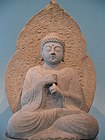
The Buddha statue of Avukana, 5th century, Sri Lanka
-
-

Song Dynasty porcelain bottle with iron pigment over transparent colorless glaze, 11th century, Chinese
-
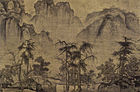
Autumn in the River Valley, Guo Xi (c. 1020–1090 AD), 1072 AD, Chinese
-
-
-

-

A screen painting depicting people playing Go, Kanō Eitoku (1543–1590), Japanese
-

Ivory carving of Christ Child with gold pigment (c. 1580–1640), Philippines
-

After Pelting at Mt. Inwang, Cheong Seon (1676–1759), Korean
-
-

Virgin Mary ivory caput with inlaid drinking glass eyes (18-19th century), Philippines
Encounter also [edit]
- History of Asia
Specific topics in Asian fine art [edit]
- Category:Arts in Asia by country
- Night in paintings (Eastern art)
- Scythian art
- History of Chinese art
- Culture of the Song Dynasty
- Ming Dynasty painting
- Tang Dynasty fine art
- Lacquerware
- Mandala
- Emerald Buddha
- Urushi-e
- Asian art
- Gautama Buddha
- Buddhism and Hinduism
- List of National Treasures of Japan (paintings)
- List of National Treasures of Japan (sculptures)
General art topics [edit]
- History of painting
- Landscape painting
Oceania [edit]
Australia [edit]
New Zealand [edit]
The Pacific Islands [edit]
References [edit]
- ^ Sullivan, Michael (1997). The Meeting of Eastern and Western Fine art (Paperback) (Revised and Expanded ed.). University of California Press. ISBN9780520212367.
- ^ Japonisme: The Japanese Influence on Western Fine art Since 1858 (Paperback) by Siegfried Wichmann# Publisher: Thames & Hudson; New Ed edition (Nov 19, 1999), ISBN 0-500-28163-seven, ISBN 978-0-500-28163-5
- ^ The Coming together of Eastern and Western Art, Revised and Expanded edition (Hardcover) past Michael Sullivan, Publisher: University of California Printing; Rev Exp Su edition (June i, 1989), ISBN 0-520-05902-6, ISBN 978-0-520-05902-3
- ^ [i] NY Times, Holland Cotter, accessed online October 27, 2007
- ^ Metropolitan Museum of Fine art, Ancient Near Eastern Art
- ^ "Central Asia :: The Collection :: Art Gallery NSW". www.artgallery.nsw.gov.au . Retrieved October 3, 2019.
- ^ A. A. Hakimov, Eastward. Novgorodova and A. H. Dani (1996). "ARTS AND CRAFTS" (PDF). UNESCO. Archived from the original (PDF) on August thirteen, 2016.
- ^ Encyclopædia Britannica, Fundamental Asian Arts. 2012. Retrieved May 17, 2012. Encyclopædia Britannica.
- ^ "Contemporary Art in Central Asia every bit an Alternative Forum for Discussions – Voices On Central Asia". June 25, 2018. Retrieved October 3, 2019.
- ^ Carr, Karen (May 31, 2017). "Key Asian Fine art". Quatr.usa Written report Guides . Retrieved Oct 3, 2019.
- ^ Hays, Jeffrey. "Civilization, Art, Crafts and Music From in Central Asia". factsanddetails.com . Retrieved October 3, 2019.
- ^ Berczi, Szaniszlo (September 15, 2009). "Ancient Art of Key-Asia". Periodical of Eurasian Studies. ane: 21–27.
- ^ Jiang, S., Du, J., Huang, Q., Huang, T., & Gao, W. (2005). Visual Ontology Construction for Digitized Art Image Retrieval. Journal Of Computer Science And Technology, 20(6), 855–860. doi: 10.1007/s11390-005-0855-x
- ^ The community distribution of bacteria and fungi on aboriginal wall paintings of the Mogao Grottoes. (2015). Scientific Reports., 5. https://doi.org/10.1038/srep07752
- ^ Kenderdine, S. (2013). "Pure Land": Inhabiting the Mogao Caves at Dunhuang. Curator: The Museum Journal, 56(2), 199–218. doi: 10.1111/cura.12020
- ^ "Mogao caves at Dunhuang". Khan University . Retrieved May 31, 2019.
- ^ Yee, C. (2019). Chinese calligraphy | Description, History, & Facts. Retrieved from https://www.britannica.com/fine art/Chinese-calligraphy
- ^ Chiang, Y. (1973). Chinese calligraphy (Vol. 60). Harvard University Press.
- ^ Cartwright, M. (2019). Jade in Ancient China. Retrieved from [https://www.worldhistory.org/article/1088/jade-in-ancient-china/ worldhistory.org]
- ^ a b Sullivan, M., & Silbergeld, J. (2019). Chinese jade. Retrieved from https://www.britannica.com/art/Chinese-jade
- ^ Shan, Jun. "Importance of Jade in Chinese Civilisation". ThoughtCo . Retrieved June 1, 2019.
- ^ Valenstein, S. Yard. (1988). A handbook of Chinese ceramics. Metropolitan museum of fine art.
- ^ "Chinese Porcelain | Silk Roads". en.unesco.org . Retrieved May 31, 2019.
- ^ Andrews, J. F., & Shen, K. (2012). The art of modern Communist china. Univ of California Press.
- ^ "History of Chinese Pop Music". world wide web.playlistresearch.com . Retrieved June 3, 2019.
- ^ "A century of Chinese oil painting". www.chinadaily.com.cn . Retrieved June iii, 2019.
- ^ Lent, J. A., & Ying, 10. (2017). Comics Art in Prc. Univ. Printing of Mississippi.
- ^ a b McKay, Alex. The History of Tibet. Routledge. 2003. p. 596-597. ISBN 0-7007-1508-viii
- ^ Birds and Bloom of the Four Seasons at wikiart.org
- ^ Kee, Joan (April 2013). "Contemporary Fine art in Early Colonial Korea: The Self Portraits of Ko Hui-dong". Art History. 36 (2): 392–417. doi:10.1111/j.1467-8365.2013.00950.x.
- ^ "Early Korean History". Early Korean History: 1. 2007.
- ^ Wille, Simone (September nineteen, 2017). Modern Art in Pakistan: History, Tradition, Place. Routledge. ISBN978-one-317-34136-9.
- ^ Blume, Nancy. "Exploring the Mandala". Asia Lodge. Asia Social club. Retrieved November nineteen, 2017.
- ^ Violatti, Cristian. "Mandala". World History Encyclopedia . Retrieved November 19, 2017.
- ^ See David Fontana: "Meditating with Mandalas", p. x
- ^ Carl Jung and the Mandala Retrieved January xiv, 2010 [ dead link ]
- ^ See C K Jung: Memories, Dreams, Reflections, pp.186–197
- ^ Brown, p. 104
- ^ "Bhutan:Arts & Crafts". Tourism Quango of Kingdom of bhutan:Government of Bhutan. Archived from the original on June 12, 2010. Retrieved June 7, 2010.
- ^ "Artisans Angkor". www.artisansdangkor.com . Retrieved October iii, 2019.
- ^ "Cambodia Faces 'Dark Episode' With Revival of Traditional Arts, Culture". Phonation of America . Retrieved Oct 3, 2019.
- ^ a b "Cambodian Civilisation and its Glorious Tradition of Artistic Do". Widewalls . Retrieved October 3, 2019.
- ^ "Arts and Crafts in Kingdom of cambodia | Asia Highlights". www.asiahighlights.com . Retrieved October 3, 2019.
- ^ Corey, Pamela (2014). "The 'First' Cambodian Contemporary Creative person" (PDF). Periodical of Central khmer Studies – via Cornell University.
- ^ "Rehabilitation and preservation of Cambodian performing arts". unesdoc.unesco.org . Retrieved October three, 2019.
- ^ "Khmer Art and Civilisation – Central khmer Culture | Tourism Cambodia". www.tourismcambodia.com . Retrieved October iii, 2019.
- ^ Phungtian, Charuwan. "Thai – Cambodian Civilisation Relationship through Arts" (PDF). Buddha Dharma Educational activity Association Inc. – via Magadh Academy.
- ^ "Art & Architecture in Cambodia | Inside Asia Tours". www.insideasiatours.com . Retrieved Oct iii, 2019.
- ^ Covarrubias, Miguel (1937). Island of Bali. Cassel.
- ^ Eiseman, Fred and Margaret (1988). Woodcarving of Bali. Periplus.
- ^ Geertz, Hildred (1994). Images of Ability: Balinese Paintings Made for Gregory Bateson and Margaret Mead. University of Hawaii Press. ISBN978-0-8248-1679-7.
- ^ Couteau, Jean (1999). Catalogue of the Museum Puri Lukisan. Ratna Wartha Foundation (i.e. the Museum Puri Lukisan). ISBN979-95713-0-8.
- ^ "Art History – A Brief History Of Vietnam Fine Art". Archived from the original on March four, 2010.
- ^ a b c Ngoc, Huu (2000). "Mod Painting: Tracing the Roots". Vietnam Cultural Window. Thế Giới Publishers. 29. Archived from the original on March half-dozen, 2012. Retrieved April 23, 2010. Full text bachelor hither Archived March 27, 2010, at the Wayback Car
- ^ Centre, UNESCO Earth Heritage. "Petroglyphs and Petrographs of the Philippines". UNESCO World Heritage Middle.
- ^ "Archived copy". Archived from the original on July vii, 2020. Retrieved July 10, 2020.
{{cite web}}: CS1 maint: archived copy as title (link) - ^ "Archived re-create". Archived from the original on January 8, 2020. Retrieved July 10, 2020.
{{cite web}}: CS1 maint: archived copy equally title (link) - ^ "Archived re-create". Archived from the original on July 29, 2020. Retrieved July 10, 2020.
{{cite web}}: CS1 maint: archived copy as championship (link) - ^ "Malay ancestors' 'balangay' declared PH's National Boat | mb.com.ph | Philippine News". December 8, 2015. Archived from the original on December 8, 2015.
- ^ Postma, Antoon (April–June 1992). "The Laguna Copper-Plate Inscription: Text and Commentary". Philippine Studies. Ateneo de Manila University. 40 (two): 182–203. JSTOR 42633308.
- ^ "Archived copy". Archived from the original on November 19, 2018. Retrieved July 10, 2020.
{{cite web}}: CS1 maint: archived copy as championship (link) - ^ Ocampo, Ambeth R. (June 26, 2019). "The Golden Tara of Agusan". inquirer.net.
- ^ "Archived copy". Archived from the original on October xviii, 2018. Retrieved July ten, 2020.
{{cite spider web}}: CS1 maint: archived copy every bit title (link) - ^ Ocampo, Ambeth R. (October 19, 2011). "History and design in Death Blankets". inquirer.cyberspace.
- ^ "Archived re-create". ncca.gov.ph. Archived from the original on April eighteen, 2021. Retrieved Jan 15, 2022.
{{cite web}}: CS1 maint: archived copy every bit title (link) - ^ "Forgotten history? The polistas of the Galleon Merchandise". Rappler.
- ^ The Project Gutenberg EBook of The Philippine Islands, 1493–1803, Volume II, 1521–1569, by Emma Helen Blair, p. 126
- ^ "Demystifying the age of the Ifugao Rice Terraces to decolonize history". Rappler.
- ^ a b c d Center, UNESCO World Heritage. "Baroque Churches of the Philippines". UNESCO World Heritage Middle.
- ^ Sembrano, Edgar Allan Chiliad. (August 25, 2014). "UST documents in aboriginal 'baybayin' script declared a National Cultural Treasure". Philippine Daily Inquirer. Archived from the original on August 25, 2014. Retrieved August 26, 2014.
- ^ Potet, Jean-Paul G. (2019). Baybayin, the Syllabic Alphabet of the Tagalogs. Lulu.com. p. 115. ISBN9780244142414.
simply an examination reveals that they cannot be earlier than the 17th century because in the excerpt shown hither, the letter nga (frames 1 and 3) has the /a/-deleter cantankerous that Begetter LOPEZ introduced in 1621, and this cross is quite different from the diacritic placed under the grapheme ya to stand for the vowel /u/: /yu/ (frame 2).
- ^ Panlilio, Erlinda Enriquez (2003). "Consuming passions: Philippine collectibles", pg. lxx. Jaime C. Laya. ISBN 9712714004.
- ^ a b "NCCA guidelines" (PDF). ncca.gov.ph. Retrieved February 24, 2020.
- ^ Howard T. Fry, "The Eastern Passage and Its Impact on Spanish Policy in the Philippines, 1758–1790", Philippine Studies, vol.33, Kickoff Quarter, 1985, pp.iii–21, p.18.
- ^ Reyes, Raquel A. G. (2008). Love, Passion and Patriotism: Sexuality and the Philippine Propaganda Movement, 1882 – 1892. NUS Press, National University of Singapore (2008). ISBN9789971693565 . Retrieved November 24, 2013.
- ^ "Archived copy". Archived from the original on May 27, 2020. Retrieved July 10, 2020.
{{cite web}}: CS1 maint: archived re-create as title (link) - ^ Lacson, Nonoy E. (July iv, 2018). "'Pearl of Sulu Bounding main' show-cased". Manila Message. Retrieved February 22, 2020.
- ^ "Collections". www.nationalmuseum.gov.ph. Retrieved February 24, 2020.
Further reading [edit]
- Arts of Korea. New York: The Metropolitan Museum of Fine art. 1998. ISBN0870998501.
- Welch, Stuart Cary (1985). Republic of india: art and civilisation, 1300-1900. New York: The Metropolitan Museum of Art. ISBN9780944142134.
External links [edit]
- Chinese Art and Galleries at China Online Museum
- Asian Fine art at the Metropolitan Museum of Art
- Freer Gallery of Art and Arthur Yard. Sackler Gallery at the Smithsonian Establishment
- Gimmicky Vietnamese Art Drove at RMIT University Vietnam
Source: https://en.wikipedia.org/wiki/History_of_Asian_art
0 Response to "Easy Asian Art to Draw Simple Chinese Art to Drawn by an Artist"
Postar um comentário